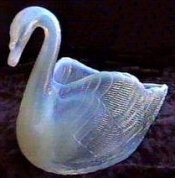
above: opalescent glass
swan posy vase by
Burtles Tate & Co of
Manchester, c. 1885.
Angela's book on
London Lampworkers


above: "greek key" by
Molineux & Webb, 1864
|
Manchester Pressed Glass: A short explanation
Manchester was the second great center producing pressed glass in England during the 19th century. The first was the North East (Gateshead, Sunderland, and Newcastle) with three giant companies Sowerby, Davidson, and Greener, and several smaller ones.
There were five glassworks in Manchester producing high quality pressed glass which today is highly collectible, plus several lesser known ones. The main five were:
- Burtles Tate
- James Derbyshire
- John Derbyshire
- Molineux & Webb
- Percival Yates & Vickers
Burtles Tate & Company operated a glassworks near Oldham Road, Manchester from 1858 to 1924, when they were absorbed into another Manchester glass company, Butterworth's. Burtles Tate are well known for their novelties, like the opalescent glass swan shown above left. Their other claim to fame is that they produced, from 1891 onwards, an opalescent colored glass shading to white at the rims, very similar to Davidson's pearline. They called this glass "Topas Opalescent" and produced it in a wider variety of colors than Davidson's pearline.
James Derbyshire was one of three brothers (James, John and Thomas) who operated glassworks in the Manchester area in the mid-19th century. James Derbyshire & Brother, of Hulme, was established in 1858; in 1867 the three brothers opened another glassworks and traded as J.J.& T. Derbyshire; and in 1876 the name changed again to James Derbyshire and Sons. This company's output was mostly high quality pressed glass tableware. They do not seem to have registered any new designs after the 1870s.
John Derbyshire was James's brother and set up his own glassworks in 1873, the Regent Road Flint Glass Works, Salford. Several of John's designs are very famous and highly sought, like the winged sphinx paperweight, the "Landseer" lion paperweight, the figure of Britannia, and the Punch & Judy figurines, all registered in the 1870s. John Derbyshire designs often carry his trademark, the initials JD on either side of an anchor. The company closed in 1876.
Molineux & Webb were the oldest of the Manchester glassworks famous for their 19th century pressed glass. They operated as a blown glassworks from 1827 and registered their first pressed glass design in 1846 (a decanter). Originally called Molineux & Co., then Molineux & Webb, and from 1865, Molineaux, Webb & Co. (note the spelling change), they were the most prolific of the Manchester glassworks. They are known to have produced a wide range of cut crystal glass, cased glass, and other hand-blown and decorated items as well as pressed glass. One of their most famous pressed designs was the Greek Key pattern, shown left. This pattern was used for a wide range of tableware, and was first registered in 1864. The company closed in 1936.
Percival Yates & Vickers operated from the 1844 to 1914 first as Percival Yates, then as Percival Yates & Vickers and from the 1870's onwards, as Percival Vickers. Their first registered design for pressed glass was in 1847 (a bottle). Most of their glass is clear good quality tableware, some with frosted designs.
Pressed glass designs from Manchester were popular in the 1860s and 1870s, earlier than the pressed glass innovations from the North East of England. Sowerby, for example, registered their first pressed glass design in 1872, and Davidson in 1877.
Find your favourite glass with our Target Searches
- save time when you are busy and don't miss an opportunity!
- CLICK HERE
|