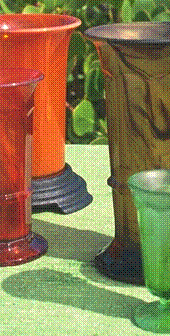
above: Cloud glass
vases by Davidson's
If you are looking for
Cloud Glass there
is always some for sale
on eBay. See what there
is just now - click
Cloud glass
Glass Encyclopedia
Click here for the full
list of latest topics
or click on any of
the following links:
Advertising glass
Akro Agate glass
Amberina glass
American glass
Ancient glass
Apothecary glass
Apsley Pellatt glass
Art Deco glass
Art nouveau glass
Arts and Crafts glass
August Walther Glass
Baccarat glass
Bagley glass
Barolac glass
Beads (glass)
Bimini glass
Blenko glass
Books on glass
Bottles (glass)
Boyd's Crystal Glass
Brierley Crystal glass
E O Brody glass
Bubble glass
Burtles Tate glass
Caithness glass
Cameo glass
Cameo incrustations
Carnival glass
Cast glass
Chance glass
Charder glass
Cire Perdue glass
Cloud glass
Cobalt blue glass
Consolidated glass
Contemporary glass
Coralene glass
Coudersport glass
Crackle glass
Cranberry glass
Custard cups (glass)
Custard glass
Cut crystal glass
Dartington glass
Daum glass
Davidson's glass
Depression glass
Dew drop glass
Dorothy Thorpe glass
Drinking glasses
Dumps
DVDs on Glass
EAPG glassware
End-of-day glass
Etling glass
European glass
Fairy Lights
Federal glass
Fenton glass
Fire-King glass
Flygsfors glass
Fostoria glass
Frank Thrower glass
French glass
Fry Glass
Galle Glass
Glass hand vases
Glass-working
Glass Dumps
Gold ruby glass
Goofus Glass
Gray-stan glass
Greeners glass
Hand vases
Hazel Atlas glass
Heisey glass
Historismus glass
Hobnail glass
Hunebelle glass
Imperial glass
Intaglio glass
Irradiated glass
Isle of Wight glass
Italian glass
Jack-in-Pulpit glass
Jade glass
James Derbyshire
Jeannette Glass
Joblings glass
Joe Rice glass
John Derbyshire
J Walsh Walsh glass
Kemple glass
King's Lynn glass
Komaromy glass
Lalique glass
Leerdam glass
Le Verre Francais
L G Wright glass
Libbey glass
Libensky glass
Lobmeyr glass
Loetz or Lotz glass
Lost wax technique
Malachite glass
Manchester glass
Marbles (glass)
Marqueterie de Verre
Mary Gregory glass
Mdina glass
Mercury glass
Milk glass
Molineux Webb glass
Monart glass
Murano glass
Nailsea glass
Nazeing glass
New Zealand glass
NZ paperweights
Northwood glass
Opalescent glass
Orient & Flume glass
Orplid glass
Orrefors glass
Pallme-Konig glass
Paperweights
Paperweights of NZ
Pate de Verre
Peachblow glass
Pearline glass
Percival Yates & Vickers
Perthshire Paperw'ts
Phoenix glass
Pictures on glass
Pilgrim glass
Pirelli glass
Powell glass
Pyrex glass
Riverside glass
Reverse paint on glass
Roman glass
Rose bowls
Royal Brierley glass
Ruby glass
Sabino glass
Scandinavian glass
Schneider glass
Shoes in glass
Silhouettes on glass
Silvered glass
Silver overlay glass
Slag glass
Sowerby glass
Spatter glass
Stained glass
St Clair glass
Steuben Glass
Stevens & Williams
Strathearn glass
Stretch glass
STS Abel Zagreb glass
Sulphides in glass
Sun changed glass
Thomas Webb glass
Tiara glass
Tiffany glass
Tiffin glass
Toothpick Holders
Tortoiseshell glass
Tudor Crystal glass
Uranium glass
Val St Lambert glass
Vasart glass
Vaseline glass
Venetian glass
Venini glass
Verlys glass
Videos on Glass
Vistosi Glass
Vitro Porcelain Glass
Walther Glass
Waterford Crystal
Webb Corbett glass
Webb, Thomas glass
Wedgwood glass
Westmoreland glass
Whitefriars glass
WMF glass
Ysart glass
Glass Message Board
Glass Museum on Line
Books on Glass
Glass Target Searches
Our Glass Blog
Useful glass links

Cloud Glass from the Glass Encyclopedia and the Glass Museum
Author Angela Bowey
Davidson's Cloud Glass
From 1867 for a hundred and twenty years George Davidon's glassworks made pressed art glass in the North East of England and exported it all around the world. One of their most successful products was Cloud Glass.
In 1922 Davidson's invented Cloud Glass, a kind of
glass with streaks like clouds, which they
aptly named "Cloud Glass" (pictured left).
It was very popular in the 1920's and 30's.
Cloud Glass was heavy pressed coloured glass with a small amount of darker glass added at the last minute to the molten glass to produce cloud-like streaks. Each piece was hand finished and had its own unique pattern in the glass. It was made in a wide range of shapes in amber, brown, purple, blue, green, orange, & (rarely) in red & grey.
The Davidson glass company had special links with New Zealand & Australia; the founder's brother had emigrated to Australia towards the end of the nineteenth century, and set up trade with England. At one stage a barter system was set up, with shiploads of glass going to New Zealand & Australia in exchange for shiploads of food for Britain. Cloud Glass was exported in large quantities. Many pieces were also taken overseas by emigrating families.
"Amber Cloud Glass" was the first colour
in "Cloud Glass" made by Davidson's of
Gateshead, followed in 1928 by a
transparent version, which Davidson's
called "Tortoiseshell". 
Sometimes the same mould was used with a slight modification for different pieces. For example the vases sometimes had a turnover rim and sometimes were flared.
Many people can still remember a Cloud Glass bowl taking pride of place on the family sideboard when they themselves were children. It was very practical as well as beautiful. The vases are heavy and very stable; they can hold tall top-heavy flowers without falling over. The bowls are sturdy and a delight to look at when the sun shines through the coloured glass.

Dressing table sets were popular in the
1930's, comprising a tray and containers
for things like powder, trinkets, & hair-
pins, usually with a bedroom candle stick.
The same designs were used by Davidson's for all their colours during this period. Jade Glass, black opaque glass, and several colours of clear glass, as well as all the colours of Cloud Glass were made in these same shapes.
During the Second World War Davidson's along with most other European factories, switched to war-related production; Cloud Glass was only briefly revived after the war.
Pressed glass should not be dismissed as inevitably inferior, just because some of the cheap forms of mass produced glass are pressed. It is equally true that some
of the most expensive glass in the world is pressed such as the glass made by Rene Lalique in France.
For this kind of good quality pressed glass, a work of art is first created in plaster and then a metal mould is made from that original model. High quality glass is then pressed into the mould and subsequently hand finished to ensure high quality.
After the war Davidson's, along with other glass manufacturers in Britain, became very busy supplying orders to meet a pent up demand for glass from the war years. But they miscalculated this market, spent money on expansion and improvements, and found themselves in financial difficulties in the 1960s. Davidson's glassworks finally closed in 1987.
If you collect or trade in Cloud glass, you can usually find items on ebay. See what is currently offered - click Cloud glass
The History of Davidson's Glass

In the 19th century, before gas lighting and electricity were used to supply lighting in homes and workplaces, oil lamps with glass chimneys were used by the million. Glass chimneys were hand blown and fragile, so they were quite expensive and always getting broken, creating a constant demand for new ones. George Davidson was a butcher in the North East of England during the 1860's. He saw an opportunity and in 1867, at the age of 45,
he decided there was such a shortage of oil lamp chimneys he would build a glass factory in the nearby Team Valley.
His lamp factory was very successful and he grasped another opportunity and introduced pressed glass-making, a partly-mechanised process, to make a wide range of pressed glass table-ware. The Americans had developed machinery for pressing glass in the early 19th century, and some English glass-makers were beginning to use this technology by the 1830's. Pressed glass was very much cheaper to produce than hand blown glass, making it a treasure which even working people could afford. Davidson's went on to be one of the most prolific and successful glass factories in the UK.
In those early years pressed glass was used to imitate hand-made glass. They imitated cut crystal designs in clear pressed glass (which they called Flint glass). These examples were made by Davidson's in the 1880s.
During the 1880's Davidson's, along with several other glass factories, also made glass to look like porcelein (termed vitro-porcelein) usually in opaque white and opaque blue (like the vase on the left above).
They also made glass to look like marble, and termed it "marble vitro-porcelein" (or sometimes marble glass or Malachite glass). The flint glass table-ware above and the marble vitro-porcelein sugar bowl below all have the Davidson's trademark or a Davidson's registration number. Marbled glass items like this sugar bowl are often called "slag glass" because the effects were acheived by adding chemicals to the glass and slag from old coal and iron mines was believed to be used.

Glass makers in England at this time came under pressure to put a trade mark or other form of identification on their glass. Davidson's registered this trade mark, of a lion sitting up on a wall, and
used it between 1880 and 1891. They discontinued it when George Davidson died.
Any piece of glass with this trademark can be accurately dated to the period 1880 to 1891.
In 1889 Davidson's introduced one of their most popular and successful lines, a colouring which they called "Pearline". It was only made in two colours, blue and lemon yellow, each with a white edge. Pearline glass was so successful that Davidson's introduced a new suite of designs made in "pearline" almost every year until 1903, and continued production of pearline until the outbreak of the First World War (1914).

Davidson's pearline glass is virtually always marked with a number or (on very early pieces) the word "Patent". The number is the British registration number of that particular pattern, and identifies the manufacturer and the date of registration. The exceptions to this rule are the small items which Davidson's marketed as "novelty" pieces, and this quilted pattern (right), which does not have a number but does appear in Davidson's advertisements of 1893. American glass collectors have named this design "Quilted pillow sham" (Heacock).

Pearline glass reacted to heat by turning
white on the parts exposed to heat during
the cooling process, a reaction caused by
the chemicals mixed into the glass
(notably arsenic). It was extremely
popular in the 1890's.
This pattern (left) was issued by Davidson's in
1889, registration number 130643, called
the "643 Suite" by Davidson's and named
"Brideshead" by American collectors. The Pearline colour combination of a
white opalescent edge on turquoise blue
glass was almost unique to Davidson's.
Greener's (from nearby Sunderland)
produced a smaller number of patterns in
a very similar colour, and these can be identified both by the registration numbers and from pattern books and advertisements of the time.

Lemon Pearline is often called "Vaseline Glass", which is a general term used for any kind of yellow glass with an appearance similar to the old yellow vaseline ointment. This includes hand blown glass as well as the output from many factories. I have come across antique dealers calling the blue pearline "vaseline glass" but know of no justification for this.
These pieces (right) are in one of the last Pearline patterns; registered by Davidson's in 1903 registration number 413701 and named "William and Mary" by US collectors (see William Heacock's publications).
The lemon colour was produced by adding uranium to the glass mixture (in those days before people knew about bombs made from uranium). If you shine an ultra-violet lamp onto Davidson's lemon pearline glass it will glow green (fluoresce) because of these ingredients.
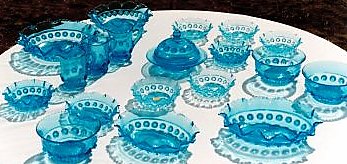
This design (left) by Davidsons is clear blue without the pearline white edge. It was introduced when "pearline" was becoming less popular in 1908. Its registration number was 533040, and this number was stamped into the moulds, so it can almost always be found if you run your finger gently over the glass. It was produced
in several colours (clear, blue, green, amber) and in vast quantities over a 40 year period,
from 1908 to the 1940's. In later years
the pieces often had chromium plated attachments.
The First World War marked the end of
the Art Nouveau period and also the end of the
parallel fashion for pressed glass patterns based on classical cut
crystal designs. The "Art Deco" period
in the 1920's and 30's was a period
of strong, bold colours and simple shapes. 
There are always examples of Davidson's glass for sale on ebay. See what is being offered just now - click Davidson glass
Here are some books which include Davidson's Glass. Click on any book cover to read more about that book.





Davidson Glass: A History (2005) by Chris Stewart and Val Stewart. This is a great book with comprehensive history, catalogue information, designs, types of glass and great photographs. It may be hard to obtain copies.
English Pressed Glass by Raymond Slack (1987). Really good information about the English pressed glass companies from late 19th and early 20th Centuries.
The Identification of English Pressed Glass, 1842-1908 by Jenny Thompson (1990). Detailed information.
British Glass 1800-1914, by Charles R. Hajdamach, (1991). One of the great reference books on British Glass.
Nineteenth Century British Glass by Hugh Wakefield (1982). Still an excellent reference book on glass factories in the early years of pressed glass.
Victorian Decorative Glass 1850-1914, by Mervyn Gulliver, (2002).
It is always interesting to see what Cloud Glass there is on eBay. You may just find something you have been looking for. Click
Cloud glass
INFORMATION about Bagley Glass!
Bagley Glass were competitors of Davidsons from the 1930s onwards so we thought you would be interested in this book.
 |
The 4th Edition is now available and has received a rave response - more information, more and better pictures, new items identified as Bagley for the first time, a helpful index, and more compehensive coverage. A truly comprehensive guide to help you identify Bagley Glass. The first three editions sold out quickly. Click on the picture for more details. |
Copyright (c) 1998 - 2021 Angela M. Bowey.
All rights reserved. Copying material from this page for
reproduction in any format is forbidden.
Written and designed by: Angela M. Bowey.
URL to this page:
http://www.glassencyclopedia.com/cloudglass.html